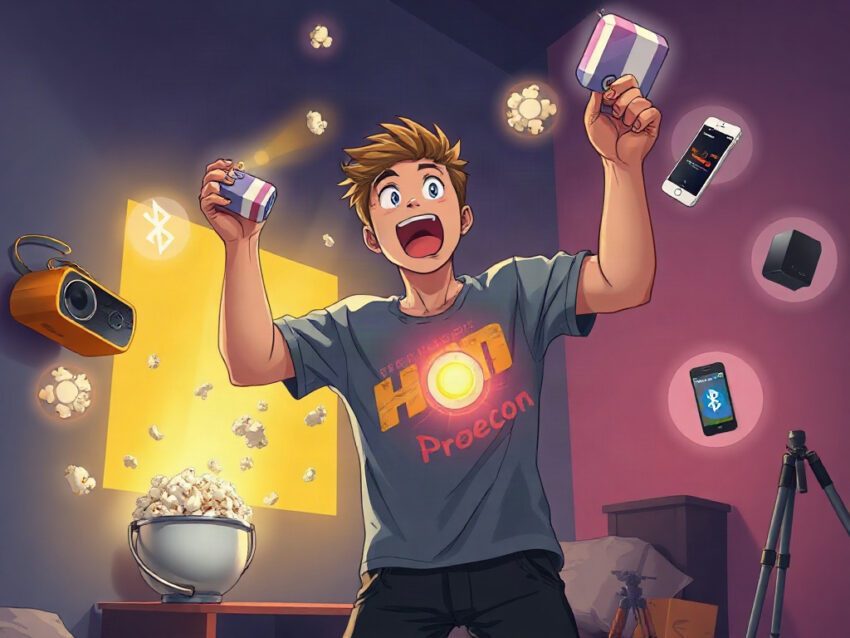
Best Portable Mini Projectors on Amazon: Small Devices, Big-Screen Dreams
Friends, there is a particular kind of magic in turning an ordinary wall into a cinema screen.
It can happen in a bedroom at 11:47 p.m., with rain tapping against the window. It can happen in a backyard where someone has hung a white sheet between two trees. It can even happen in a cramped apartment, where the coffee table is covered with popcorn, charging cables, and one remote nobody can find.
A portable mini projector does not simply display an image. It changes the mood of a room.
But choosing one on Amazon can feel like walking through a crowded electronics market. Every product promises “4K support,” “cinematic quality,” “powerful brightness,” and “smart entertainment.” Some offer excellent value. Others use impressive words to hide disappointing hardware.
So which portable mini projectors are actually worth considering? The answer depends on what you want to watch, where you will use the projector, and how much inconvenience you are willing to tolerate.
This guide explores the best portable mini projector categories and models commonly found on Amazon, explains the specifications that matter, and helps you avoid the traps hidden behind polished product descriptions.
Why portable mini projectors have become so popular
A television is dependable. It also occupies a permanent place in your home.
A mini projector is different. You can place it on a shelf, carry it in a backpack, or pack it beside a blanket for an outdoor movie night. When the film ends, the screen disappears. The room becomes a room again.
That flexibility explains the appeal.
Portable projectors are especially useful for:
- Bedroom movie nights
- Dorm rooms and small apartments
- Backyard entertainment
- Children’s rooms
- Travel and camping
- Business presentations
- Gaming in unusual spaces
- Watching sports with friends
- Temporary home theaters
The best portable mini projectors on Amazon usually combine several features:
- Compact design
- Native 720p or 1080p resolution
- HDMI and USB connections
- Wireless screen mirroring
- Bluetooth audio
- Automatic or manual keystone correction
- Adjustable focus
- Built-in streaming support
- A simple setup process
That last point matters more than many buyers realize. A projector can produce a beautiful picture, but if it takes twenty minutes to connect, update, restart, and negotiate with your phone, the excitement disappears quickly.
Nobody wants to spend movie night whispering, “Why is it connected but not playing?”
The most important specification: native resolution
Projector descriptions often use phrases such as “supports 4K” or “compatible with 1080p.” These statements can sound impressive, but they do not necessarily mean the projector creates a true 4K or 1080p image.
Native resolution tells you what the projector actually displays.
A projector with native 1080p resolution produces a 1920 × 1080 image. A projector with native 720p resolution produces a 1280 × 720 image. A model that merely “supports 4K” may accept a 4K signal while displaying it at a much lower resolution.
For most portable home use:
- Native 1080p gives the sharpest image for films, subtitles, sports, and games.
- Native 720p can still look enjoyable on a smaller screen.
- Very low-resolution models may appear soft, especially with text.
- “4K supported” should never be treated as the same thing as native 4K.
Imagine looking at a city skyline through a clean window. Fine lines remain crisp. Now imagine looking through a thin layer of fog. The buildings are still there, but the details blur together. Resolution creates that difference.
A native 1080p projector is usually the safer choice if the price difference is reasonable.
Brightness claims require caution
Brightness is one of the most confusing areas in projector shopping.
Amazon listings may advertise thousands of lumens, sometimes with numbers that seem wildly higher than those used by established brands. The problem is that manufacturers do not always present brightness using the same measurement standards.
A projector’s real-world brightness depends on:
- The measurement method
- The image mode
- The lamp or LED system
- The distance from the wall
- The color of the surface
- The amount of ambient light in the room
For a satisfying picture, the room should be dark or at least dim. Even an expensive projector struggles against direct sunlight.
A small projector in a dark bedroom can look surprisingly impressive. The same projector may appear washed out at noon beside an uncovered window.
Before buying, ask:
- Will I use it at night?
- Can I close curtains or blinds?
- Do I need it for daylight presentations?
- Will the image be projected onto a white wall or a proper screen?
If you primarily watch films in the evening, moderate brightness may be perfectly adequate. If you want to watch sports during the afternoon, brightness becomes much more important.
The best portable mini projector choices
The “best” projector does not exist in isolation. The best model for a student may be a poor choice for a family, while the ideal outdoor projector may be excessive for a bedroom.
Here are the most useful categories to consider when browsing Amazon.
Best overall for portability: Anker Nebula Mars 3 Air
The Anker Nebula Mars 3 Air is often highlighted for its balance of picture quality, sound, ease of use, and portability.[9] It belongs to the more premium end of the portable projector market, but it is designed for people who want fewer compromises.
Its appeal comes from the complete experience.
You get a compact design, integrated sound, smart features, and a form that is easier to carry than a traditional home theater projector. Instead of building a system from separate pieces, you can take one device from the living room to the bedroom or outside.
It makes sense for buyers who value:
- Better overall build quality
- Reliable software
- Convenient portability
- Stronger integrated audio
- A polished user experience
- Occasional outdoor use
Picture quality is only part of the story. The other part is friction.
A projector can have a sharp image, but if its menus feel sluggish and its wireless connection fails repeatedly, you will eventually stop using it. Premium portable models attempt to solve that problem by making the whole experience smoother.
The Mars 3 Air is especially attractive for people who want a portable projector that feels like a finished consumer product rather than a collection of uncertain specifications.
Its main disadvantage is the price. Budget buyers may find cheaper models that produce a surprisingly enjoyable image, especially in a dark room.
Best budget option: TMY Mini Projector
TMY mini projectors frequently appear among Amazon’s popular portable projector listings. One commonly listed model offers 1080p support, Bluetooth connectivity, compatibility with smartphones, HDMI, USB, TV sticks, and other devices, and may include a projection screen.[3]
This type of projector appeals to first-time buyers who want to experiment without spending a great deal of money.
The built-in or bundled screen can be useful. A blank wall works, but a screen gives you a more consistent surface, especially if the wall has texture or an uneven color.
A budget TMY projector may be suitable for:
- Children’s movies
- Occasional bedroom use
- Backyard films after sunset
- Casual streaming
- Presentations in dim rooms
- A low-cost gift
The important word is occasional.
Budget projectors often require more patience. You may need to adjust focus manually, connect an external streaming device, position the projector carefully, and keep the room dark. That is not necessarily a problem. Some people enjoy the ritual of setting up a movie night.
But if you expect instant, television-like convenience, a budget model may frustrate you.
The safest approach is to treat a low-cost mini projector as an affordable entertainment accessory, not as a complete replacement for a high-quality television.
Best smart budget category: Wi-Fi mini projectors with built-in apps
Amazon offers many compact projectors that advertise built-in apps, Wi-Fi, Bluetooth, auto keystone correction, and support for 1080p or 4K input. Current listings include models with Android-based interfaces, Wi-Fi 6, Bluetooth 5.x, automatic image adjustment, and compatibility with HDMI, USB, phones, laptops, gaming consoles, and TV sticks.[1][2][5]
These projectors seem attractive because they promise everything in one small box.
You turn it on. You open an app. You watch a film.
That is the dream.
In practice, built-in software quality varies significantly between brands. Some interfaces are smooth enough. Others feel dated, cluttered, or difficult to navigate. App compatibility can also change, and certain streaming services may work more reliably through an external device such as a Roku, Fire TV Stick, Apple TV, or Chromecast.
When evaluating a smart projector, look for:
- Recent operating-system support
- Clear information about included apps
- HDMI compatibility
- USB playback support
- Reliable wireless casting
- Firmware-update information
- A remote control with useful navigation buttons
Built-in apps are convenient, but an HDMI input remains essential. It gives you an escape route if the projector’s software becomes slow or a streaming app stops working.
Best for outdoor movie nights: a battery-powered projector
Outdoor projection creates memories because it changes the scale of an ordinary evening.
A garden becomes a theater. A driveway becomes a front row. People who planned to watch one episode remain outside for three hours because the air feels warm and the night seems unusually generous.
For outdoor use, portability means more than a small body. You need:
- Battery operation or a nearby power source
- Strong enough brightness for the environment
- Built-in or Bluetooth audio
- Easy setup
- A stable stand or tripod mount
- Protection from dust, moisture, and accidental bumps
- A screen or smooth projection surface
A battery-powered model is convenient, but battery life depends on brightness, volume, wireless activity, and settings. A projector may run for several hours under ideal conditions but less time when brightness is increased.
Do not place any projector where dew, rain, or spilled drinks can reach it. “Portable” does not automatically mean waterproof.
For a backyard setup, the projector should sit on a level surface, preferably inside a ventilated protective area. Keep cables away from walking paths. A dark sheet or proper outdoor screen will usually provide a better image than a rough brick wall.
And remember the neighbors. A movie night becomes less charming when the soundtrack travels across the entire street after midnight.
Best for gaming: low input lag and reliable HDMI
Gamers often focus on resolution and screen size, but input lag can matter more.
Input lag is the delay between pressing a button and seeing the result on the screen. A small delay may not matter during a turn-based game. In a racing game, fighting game, or competitive shooter, it can make the controls feel strangely disconnected.
For gaming, prioritize:
- HDMI input
- Low input lag
- Native 1080p resolution
- Good focus across the entire image
- A stable refresh rate
- Minimal image-processing delay
- Adequate built-in cooling
A giant projected image can be exhilarating. Your character suddenly appears larger than life, and a group of friends can watch without crowding around a small display.
Still, cheap projectors may introduce delay, and product descriptions do not always state the measurement clearly. Check recent customer reviews for comments about gaming responsiveness rather than relying only on marketing language.
A projector also works best when placed directly in front of the screen. Excessive keystone correction can reduce image quality and make text or game interfaces look softer.
Best for bedrooms and small apartments
A bedroom projector does not need to illuminate a giant outdoor screen. It needs to create a comfortable image without filling the room with noise or heat.
Look for:
- Compact dimensions
- Quiet fan operation
- Manual or automatic focus
- Flexible placement
- A tripod socket
- Bluetooth audio
- Sleep-friendly brightness controls
- Easy access to HDMI
A 60- to 100-inch image can feel enormous in a small room. At first, the effect may seem luxurious. Then you discover that the projector is angled slightly upward, the image spills across the ceiling, and subtitles disappear into a corner.
Placement matters.
If possible, set the projector at the same height as the center of the screen. Keep it perpendicular to the wall. Use keystone correction only when necessary. The more the projector digitally reshapes the image, the more detail you may lose.
Some users project onto the ceiling while lying in bed. It sounds slightly ridiculous until you try it. Then ordinary television feels strangely upright.
What “auto keystone” really does
Keystone correction adjusts a picture that appears trapezoidal because the projector does not face the screen directly.
Automatic keystone correction can save time. The projector detects the angle and reshapes the image. Some newer models also offer automatic focus, obstacle avoidance, and screen alignment.
These features are convenient, especially for portable use. You can place the device on a table without spending several minutes adjusting the image.
However, correction has limits.
If the projector sits at a severe angle, automatic keystone may create a perfectly rectangular image that looks less sharp. The projector is effectively using fewer pixels for the corrected picture.
For the best result:
- Place the projector as squarely as possible.
- Use a level surface.
- Keep the lens centered on the screen.
- Use digital correction for small adjustments.
- Prefer physical placement over extreme software correction.
Automation should remove small annoyances, not compensate for impossible positioning.
Why built-in speakers are not enough for every situation
A projector’s built-in speaker can be useful. It is better than carrying nothing, and many compact models produce adequate sound for a quiet bedroom.
But sound changes dramatically outdoors or in a larger room.
The fan may become audible. Voices may lack warmth. Action scenes may sound thin. Music may lose its sense of space.
Bluetooth support lets you connect:
- Portable Bluetooth speakers
- Soundbars
- Wireless headphones
- Earbuds
- Some home theater systems
Check whether the projector supports Bluetooth audio output rather than merely Bluetooth input. Those are different functions.
A projector may connect to a phone for music while refusing to send movie audio to your Bluetooth speaker. Product descriptions can make this distinction surprisingly unclear.
If sound matters, HDMI ARC or a 3.5-millimeter audio output can also be valuable. Wired connections usually create fewer synchronization problems.
There is a moment when a movie becomes truly immersive: not when the image grows large, but when the dialogue arrives cleanly and the room stops reminding you about the equipment. Good audio helps the illusion take hold.
📢 Join Our Telegram Channel
Get real-time updates on new deals, price drops, and hidden tech gems.
⏰ Be first to see hot offers🛒 Direct links to products🎯 Focus on practical, useful tech

## How to choose a portable mini projector on Amazon
The Amazon search page can overwhelm you with hundreds of near-identical listings. Two projectors may show the same cheerful family, the same darkened room, and the same promise of “cinematic entertainment,” yet perform very differently.
A practical buying process helps.
Start with your use case, not the advertised discount.
Ask yourself:
- Where will I use the projector most often?
- Will I watch mainly at night?
- Do I need battery power?
- Will I connect a game console?
- Do I need built-in apps?
- Can I use an external streaming stick?
- How large will the image be?
- Do I care about portability more than brightness?
- Will I rely on built-in speakers?
- What happens if the fan is noisy?
Your answers will eliminate many unsuitable products before you compare prices.
Native 1080p versus 720p
For many buyers, this is the central decision.
A native 720p projector may be enough for cartoons, casual videos, and occasional outdoor entertainment. It can also make sense when the viewing distance is several feet and the screen is not enormous.
Native 1080p is preferable when you want:
- Sharper subtitles
- More detailed films
- Better sports viewing
- Clearer presentations
- More comfortable gaming
- A larger screen
- Longer-term value
A 1080p projector generally costs more, but the difference becomes obvious when the image fills a large wall.
Think of it like a printed photograph. A small image can hide imperfections. Enlarge it, and every weakness becomes visible.
Streaming compatibility and the Netflix problem
Many mini projectors advertise smart operating systems and built-in entertainment apps. Buyers sometimes assume that every service will work automatically.
That assumption can lead to disappointment.
Streaming platforms use licensing, device certification, and software requirements. A projector may include one app while lacking official support for another. Some devices depend on screen mirroring, which can be restricted by content-protection systems.
The most dependable setup often includes:
- An HDMI port
- A compatible streaming stick
- Stable Wi-Fi
- A remote control
- A power adapter with enough capacity
If a product listing says “supports Netflix,” examine the wording carefully. Does it mean the app is officially installed? Does it require a separate device? Does it support HD playback? Customer reviews may reveal practical limitations.
This is one reason HDMI remains more important than a long list of built-in apps.
Wi-Fi and wireless screen mirroring
Wireless casting can be wonderfully convenient. You find a video on your phone, tap a button, and the image appears on the wall.
It can also fail at the worst possible moment.
The projector and phone may need to use the same network. Some devices support Android casting more reliably than iPhone mirroring, or vice versa. Certain apps may block wireless duplication.
Before purchasing, verify:
- Whether the projector supports your phone’s operating system
- Whether it uses standard casting protocols
- Whether the projector can connect to 5 GHz Wi-Fi
- Whether an HDMI alternative is available
- Whether users report connection drops
Wireless features should make your life easier. They should not become the only way to watch.
Fan noise and heat
Every projector creates heat. A cooling fan removes it, and compact devices often have less room for airflow.
Fan noise may not matter during an action film. It becomes much more noticeable during quiet dialogue, meditation videos, lectures, or bedtime viewing.
Customer reviews can help identify this issue. Search specifically for phrases such as:
- “Fan noise”
- “Overheats”
- “Gets hot”
- “Quiet”
- “Sleep use”
- “Loud during movies”
Do not block ventilation openings with books, blankets, or cushions. A projector needs airflow, even when it looks like a harmless little box.
Place it on a hard, level surface. Allow space around the vents. Let the device cool before packing it into a case.
Throw distance and image size
Throw distance is the space between the projector lens and the screen.
A standard mini projector may need several feet to create a large image. In a small bedroom, that can be inconvenient. A short-throw projector can produce a large picture from a shorter distance, but it usually costs more.
Before buying, measure:
- The distance from your intended projector position to the wall
- The width of the available wall
- The height of furniture that may block the image
- The location of power outlets
- The distance to your speaker or streaming device
A 120-inch image sounds exciting until you discover that the projector must sit in the middle of the room.
A smaller, properly focused image often looks better than an oversized image with poor brightness and blurred corners.
The projection surface changes everything
A projector cannot create a perfect image on every surface.
The best options include:
- A matte white projector screen
- A smooth white wall
- A light-gray screen in a darker room
- A clean white sheet stretched tightly
Avoid:
- Textured walls
- Glossy surfaces
- Dark patterned wallpaper
- Wrinkled sheets
- Uneven brick
- Strongly colored walls
A wrinkle in a sheet can turn a straight subtitle line into a small wave. The audience may not consciously identify the problem, but the image will feel less polished.
A screen does not need to be expensive. Even a simple, properly stretched surface can improve contrast and clarity.
A simple setup that produces a better image
You do not need professional equipment to improve a mini projector’s performance.
Try this sequence:
- Darken the room as much as possible.
- Place the projector on a stable, level surface.
- Aim it directly at the center of the screen.
- Adjust physical position before using keystone correction.
- Focus the image using small movements.
- Connect an external speaker if dialogue sounds weak.
- Use the highest-quality source available.
- Keep the projector’s vents clear.
- Allow the unit to cool before storage.
The difference between a disappointing picture and an enjoyable picture often comes from setup rather than price.
A cheap projector in a dark room on a smooth screen can look better than an expensive projector pointed at a wrinkled sheet beside a bright lamp.
Common mistakes buyers make
A few mistakes appear again and again.
Buying the largest advertised number
The biggest brightness or resolution number does not automatically indicate the best product. Look for native resolution, transparent specifications, and consistent customer feedback.
Assuming every smart feature works perfectly
Built-in apps and wireless casting can vary. Keep an HDMI connection available.
Ignoring the room
A projector designed for dark rooms will not perform well in bright daylight. Plan around your actual environment.
Forgetting audio
A giant picture with weak sound feels strangely empty. Check Bluetooth output and audio connections.
Using extreme keystone correction
Digital correction can reduce sharpness. Position the projector properly whenever possible.
Expecting a television replacement
A mini projector offers flexibility and atmosphere. A television usually offers brighter images, easier daytime viewing, and faster everyday use.
Trusting only the star rating
Read recent reviews, especially those mentioning focus, overheating, app compatibility, fan noise, remote control quality, and long-term reliability.
A useful comparison checklist
Before clicking “Add to Cart,” compare the following:
| Feature | What to look for |
|---|---|
| Native resolution | Prefer native 1080p for sharper large-screen viewing |
| Brightness | Consider the room, screen size, and time of day |
| Focus | Manual focus is acceptable; auto focus adds convenience |
| Keystone correction | Helpful for small placement errors |
| Connectivity | HDMI should be considered essential |
| Wireless features | Confirm compatibility with your phone |
| Audio | Check Bluetooth output and wired options |
| Battery | Useful for outdoor or travel use |
| Noise | Read customer comments about fan volume |
| Warranty | Favor brands that clearly explain support |
| Accessories | A case, tripod mount, or screen can add real value |
| Streaming | Verify whether apps are officially supported |
Which projector should you choose?
Choose a premium portable model such as the Anker Nebula Mars 3 Air if you want a polished experience, strong portability, and fewer compromises.[9]
Choose a budget TMY-style projector if you want an affordable introduction to big-screen viewing and understand that setup may require patience.[3]
Choose a smart Wi-Fi mini projector if built-in apps, wireless casting, and compact home entertainment matter most, but keep an HDMI streaming device as a backup.[1][2][5]
Choose a battery-powered model for outdoor movie nights, travel, and places where a power outlet is not convenient.
Choose a native 1080p projector for the best balance of clarity and price when watching films, sports, or games on a larger wall.
The perfect choice depends less on the loudest advertisement and more on the quiet details of your real life: the size of your room, the darkness of your evenings, the patience you have for setup, and the people who will sit beside you when the lights go out.
The real value of a mini projector
A portable projector will not improve every movie.
It will not transform a weak story into a masterpiece or make a noisy room suddenly peaceful. It cannot replace the warmth of conversation, the smell of fresh popcorn, or the friend who falls asleep fifteen minutes after the opening credits.
But it can create a setting in which ordinary moments feel different.
A child may remember the first film projected across the bedroom wall. A couple may turn a Tuesday night into a tradition. Friends may sit on a lawn beneath a darkening sky and laugh at a scene they have already seen three times.
That is the real value.
The technology remains small. The feeling does not.
Before choosing a portable mini projector on Amazon, compare native resolution, brightness, connectivity, sound, battery life, and real customer experiences. Then choose the model that fits your room and your habits—not the one with the most dramatic words printed on its product page.
Because sometimes the best screen is not the largest one.
Sometimes it is the wall in front of you, the people beside you, and the sudden feeling that an ordinary evening still has room for wonder.
📢 Join Our Telegram Channel
Get real-time updates on new deals, price drops, and hidden tech gems.
⏰ Be first to see hot offers🛒 Direct links to products🎯 Focus on practical, useful tech