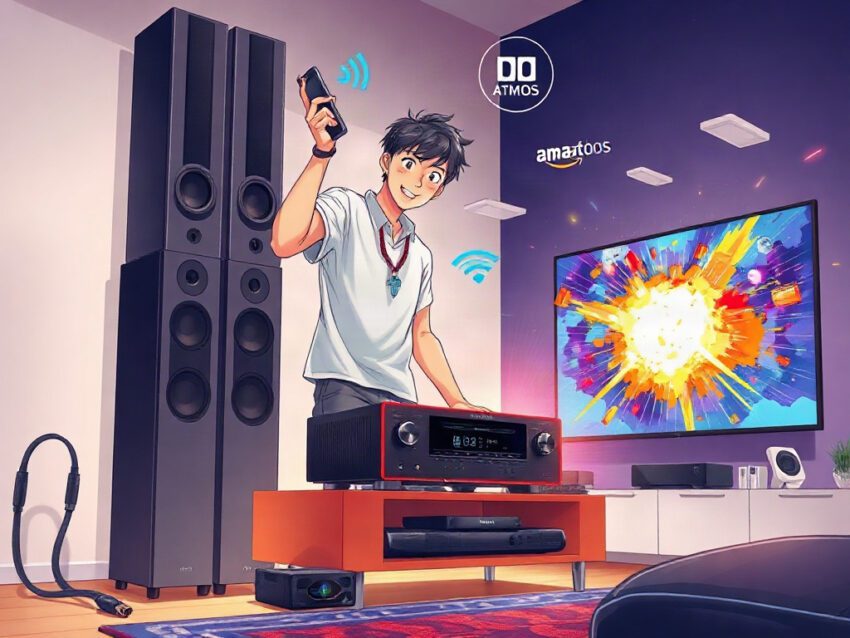
Best Home Theater Systems And AV Receivers On Amazon
A good home theater does more than make explosions louder. It changes the shape of an evening. The room darkens, the television glows, a familiar voice whispers from the center speaker—and suddenly the sofa feels less like furniture and more like the front row of a cinema.
Friends, choosing the right home theater system on Amazon can feel overwhelming. There are soundbars, 2.1 systems, 5.1 speaker packages, Dolby Atmos kits, and AV receivers with enough ports to resemble a small control room. Some products promise “cinematic sound” for less than the price of dinner. Others cost more than the television they are meant to accompany.
The trick is not to buy the most expensive system. It is to buy the system that fits your room, your habits, your equipment, and your patience.
Current Amazon listings include everything from compact soundbars under $60 to complete Yamaha and Klipsch packages costing well over $1,000.[1][4] Popular AV receiver choices include the Sony STR-DH790, Onkyo TX-NR6100, Denon models, and several inexpensive stereo amplifiers.[2][6]
So what should you actually buy?
The short answer:
- Best simple upgrade: ULTIMEA or another compact 2.1 soundbar system
- Best complete starter package: Yamaha YHT-4970U
- Best budget true surround system: Rockville HTS56
- Best receiver for a growing system: Onkyo TX-NR6100
- Best enthusiast receiver: Denon AVR-X3800H
- Best affordable Atmos receiver: Sony STR-DH790
- Best premium speaker bundle: Klipsch Reference Cinema Dolby Atmos system
But the real answer requires a little more thought.
What a home theater system actually includes
People often use “home theater system” to describe several completely different products. That confusion causes many disappointing purchases.
A complete system may include:
- A soundbar
- A separate subwoofer
- Wireless or wired rear speakers
- A set of passive speakers
- An AV receiver
- Speaker wire
- HDMI cables
- A remote control
- Room-calibration software
- Streaming or Bluetooth features
A compact soundbar is usually the easiest solution. You connect it to the television, place it beneath the screen, and begin watching. Some models include a built-in subwoofer, while others add a separate bass unit.
A 5.1 system contains:
- Three front channels: left, center, and right
- Two surround channels
- One subwoofer
A 7.1 system adds two more surround channels. A 5.1.2 Dolby Atmos system adds two height channels, either through ceiling speakers or upward-firing drivers.
The numbers look complicated, but the idea is simple. The first number describes the main speakers. The second describes the subwoofer. The third describes the height speakers.
A 5.1.2 setup, for example, has five main channels, one subwoofer channel, and two height channels.
That extra “.2” can make rain seem to fall from above rather than merely around you. In a good room, a helicopter can move overhead. In a poor room, it may sound like someone dropped a metal bucket on the ceiling.
Soundbar or AV receiver?
This is the first major decision.
A soundbar makes sense when:
- You want a quick installation
- Your room is small or medium-sized
- You mainly watch television and streaming services
- You dislike visible cables
- You do not plan to expand the system
- You want better dialogue than the television provides
An AV receiver makes sense when:
- You want separate left, center, right, and surround speakers
- You own a game console, Blu-ray player, streaming box, or turntable
- You want Dolby Atmos
- You plan to upgrade over time
- You need several HDMI inputs
- You care about realistic stereo music as well as movies
A soundbar is like a well-organized studio apartment. Everything has its place, and you can settle in quickly.
An AV receiver system is a house.
It requires more planning. It demands speaker placement. It introduces cables, settings, distances, and sometimes a moment of mild panic when the center speaker refuses to produce dialogue because one menu option is wrong. But it also gives you space, flexibility, and a more convincing soundstage.
CNET notes that receivers are particularly useful when buyers want to mix and match speakers or connect several sources, including record players and multiple HDMI devices.[3]
Ask yourself one honest question: Do I want convenience, or do I want a system I can grow into?
Neither answer is wrong.
Best compact systems for everyday television
For many households, the best home theater system is not a giant collection of speakers. It is a compact soundbar that improves dialogue, adds bass, and does not require an evening of cable management.
The ULTIMEA Poseidon M20 Pro appears among Amazon’s current best-selling home theater systems, offering a 2.1-channel design, built-in subwoofer, Bluetooth 5.4, optical and auxiliary inputs, and app control.[1] Its compact format suits bedrooms, apartments, home offices, and living rooms where a full speaker arrangement would look excessive.
The appeal is obvious. You can place the bar beneath the television, connect it through optical or HDMI when supported, and avoid surrounding the room with black boxes.
A compact system works especially well for:
- News and talk shows
- Sports
- Sitcoms
- YouTube
- Casual movie nights
- Small apartments
- Bedrooms
- Gaming at moderate volume
The built-in subwoofer will not shake the windows like a dedicated 10-inch bass enclosure. That is not a criticism; it is physics. Small cabinets have limits. Still, the improvement over ordinary television speakers can feel dramatic, especially in voices and low-volume listening.
The RIOWOIS 17-inch soundbar offers another small-footprint option with optical, auxiliary, and Bluetooth inputs, while the Rockville RHB70 combines a compact 2.1 design with Bluetooth, USB, SD playback, RCA input, and an FM radio.[1] These systems prioritize low cost and flexibility rather than high-end refinement.
Before buying one, check the television’s available outputs:
- HDMI ARC or eARC
- Optical digital output
- 3.5 mm headphone output
- Bluetooth
- RCA output
HDMI ARC or eARC is usually the most convenient choice because it can allow the television remote to control volume. Optical works reliably but may require a second remote. Bluetooth is useful for music but can introduce delay during video playback.
Best complete starter package: Yamaha YHT-4970U
The Yamaha YHT-4970U is one of the most appealing choices for someone who wants a genuine speaker-based home theater without assembling every component separately. Amazon lists it as a 5.1-channel system with an AV receiver, five speakers, powered subwoofer, Dolby Atmos support, 4K/120Hz capability, 8K support, HDMI eARC, and Bluetooth.[1][4]
That list matters because a complete package removes much of the guesswork.
You do not have to wonder whether the receiver can power the speakers. You do not have to calculate whether the center channel matches the front pair. You do not have to spend three nights reading speaker-impedance forums while a half-built system waits on the floor.
The Yamaha package is particularly attractive for:
- First-time home theater buyers
- Medium-sized living rooms
- Families who want a complete solution
- Console gamers
- Movie lovers who want real surround sound
- Buyers who prefer one brand across the system
The system’s 4K/120Hz and 8K-oriented connectivity also gives it a longer useful life for modern televisions and gaming consoles.[1] You may not need 8K today, but buying a receiver with current video standards can reduce the chance of an expensive replacement later.
Its limitations are just as important:
- The included speakers are compact
- The receiver may not satisfy demanding audiophiles
- Speaker wires still need to be hidden
- Atmos performance depends heavily on placement and ceiling height
- The package offers less upgrade freedom than a carefully chosen separates system
Still, as a complete entry point, the YHT-4970U makes sense. It gives a beginner a coherent system rather than a pile of unrelated equipment.
Best budget true surround system: Rockville HTS56
The Rockville HTS56 targets buyers who want several speakers and a dedicated subwoofer without spending premium-brand money. Amazon listings describe it as a 5.1-channel Bluetooth home theater system with an 8-inch subwoofer, optical television input, USB and SD support, microphone inputs, and an advertised 1,000-watt peak figure.[1]
That final word—peak—deserves attention.
Manufacturers often advertise peak power because it produces a large number. Peak wattage describes short-term maximum output, not necessarily the continuous power available during ordinary listening. When comparing products, look for RMS power, sensitivity, impedance, and independent testing whenever possible.
The HTS56 may suit someone who values:
- Strong bass on a budget
- A physical 5.1 speaker layout
- Bluetooth music playback
- Karaoke or microphone inputs
- A dramatic sound for action films
- A large room where a small soundbar feels underpowered
The system is less suitable for buyers who want polished construction, extensive receiver features, advanced room correction, or a refined music presentation.
A cheap surround system can still be fun. That matters. Not every purchase needs to become an audiophile project. If the goal is to watch action movies with friends on a Saturday night, a system that makes the room rumble may deliver exactly what the owner wants.
But place the subwoofer thoughtfully. Do not bury it inside a cabinet. Leave breathing room around the enclosure. Try different locations, because moving the subwoofer by a few feet can change the bass more than turning a knob.
Best premium speaker system: Klipsch Reference Cinema Dolby Atmos
Klipsch remains a strong choice for buyers who want recognizable horn-loaded dynamics and a more serious speaker package. Current Amazon results include Klipsch Reference Cinema systems with Dolby Atmos, including 5.1.4 configurations and bundles paired with Onkyo receivers.[1][3]
A 5.1.4 system uses four height channels, which can create a broader and more enveloping Atmos field than a basic 5.1.2 arrangement. It can place sound above and around the listener with greater precision—provided the room allows proper installation.
The Klipsch approach often appeals to people who want:
- High sensitivity and energetic playback
- Clear dialogue
- Strong movie impact
- A traditional speaker system
- Upgrade potential
- A theater-like presentation at home
Yet a premium speaker package does not automatically create premium sound. Room acoustics still matter. A bare room with hardwood floors, large windows, and empty walls can produce sharp reflections and tiring treble. A rug, curtains, bookshelves, and furniture can make the same speakers sound more natural.
This is one of the quiet truths of home theater: the room participates in the performance.
You can spend thousands on electronics and then place the center speaker inside a cabinet, where its sound bounces against the shelf. You can buy powerful tower speakers and push them into a corner. You can install Atmos speakers behind the listening position and wonder why overhead effects feel vague.
The equipment matters. Placement often matters more.
Why the AV receiver is the heart of the system
An AV receiver performs several jobs at once:
- It switches video sources
- Decodes surround formats
- Powers passive speakers
- Sends video to the television or projector
- Handles HDMI connections
- Manages speaker distances and levels
- Often supports Bluetooth, Wi-Fi, music streaming, and voice assistants
- Applies room correction
That makes the receiver the nerve center of a traditional home theater.[2]
Imagine the receiver as the conductor of an orchestra. It does not produce every sound by itself, but it decides which instrument plays, when it enters, how loudly it performs, and where the audience perceives it.
A receiver should match your intended system, not merely your current television.
A small receiver may be sufficient for a 5.1 living-room setup. If you plan to add height speakers, extra zones, multiple subwoofers, or larger speakers, buy with the future in mind.
Important specifications include:
- Number of amplified channels
- Number of HDMI inputs
- HDMI 2.1 support
- 4K/120Hz compatibility
- 8K support
- Dolby Atmos and DTS:X decoding
- eARC
- Room-correction system
- Network streaming
- Pre-outs for external amplification
- Subwoofer outputs
- Power ratings at realistic impedance
Do not let one impressive specification dominate your decision. “200 watts per channel” may sound powerful, but manufacturers sometimes measure one channel at a time under conditions that do not reflect real home theater use.
Look for independent testing or detailed specifications. Consider speaker sensitivity and room size. A highly sensitive speaker may play loudly with less amplifier power, while a difficult-to-drive speaker may require a stronger receiver.
📢 Join Our Telegram Channel
Get real-time updates on new deals, price drops, and hidden tech gems.
⏰ Be first to see hot offers🛒 Direct links to products🎯 Focus on practical, useful tech

## Best affordable Atmos receiver: Sony STR-DH790
The Sony STR-DH790 remains one of the most recognizable entry-level AV receivers for buyers who want Dolby Atmos without moving immediately into premium pricing. Amazon-related listings show strong buyer activity and thousands of ratings for the model.[2][9]
Its appeal comes from a straightforward combination:
- 7.2-channel architecture
- Dolby Atmos and DTS:X support
- 4K HDR video compatibility
- Bluetooth
- Support for a 5.1.2 speaker layout
- Automatic calibration
- A relatively approachable design
A 7-channel receiver can power a conventional 5.1 system and still support two additional height speakers in a 5.1.2 configuration. That makes the STR-DH790 more flexible than a basic 5-channel model.
It is a good match for:
- First-time receiver owners
- Small and medium rooms
- Buyers building a 5.1.2 system
- Movie and gaming setups
- Users who want fewer advanced networking features
- People who prefer a recognizable mainstream brand
The Sony is not the obvious choice for someone who wants a complex 9-channel system, multiple independent zones, extensive pre-outs, or advanced future expansion. But for a modest Atmos room, it provides a sensible foundation.
There is something reassuring about a receiver that does not try to be everything. A complicated menu can make a new owner feel as if the equipment is testing them. The STR-DH790 aims more at “connect the speakers and watch a film” than “become an audio systems engineer.”
Best mid-range receiver for gaming and expansion: Onkyo TX-NR6100
The Onkyo TX-NR6100 is a strong choice for buyers who want modern gaming connectivity and a receiver that can anchor a serious mid-range system. CNET identifies it as an 8K receiver and recommends it for buyers who value modern video compatibility, particularly gamers.[3]
The receiver offers features that matter to current setups:
- 7.2-channel amplification
- Dolby Atmos and DTS:X
- HDMI 2.1 support
- 4K/120Hz gaming capability
- 8K video support
- Multiple HDMI inputs
- Network and streaming features
- Room calibration
- Compatibility with a 5.1.2 system
Why does 4K/120Hz matter? A compatible game console or computer can deliver smoother motion at high frame rates, but the entire signal chain must support it: source device, HDMI cable, receiver, and television. One incompatible link can force the system to fall back to a lower mode.
This is where shopping gets less glamorous. You may spend hours dreaming about cinematic bass and then discover that the HDMI cable in a drawer is too old for the feature you bought.
Before installation, verify:
- Your television supports the required refresh rate
- The console supports 4K/120Hz
- The receiver’s HDMI input supports the needed bandwidth
- The cable meets the relevant speed specification
- The correct HDMI port is being used
- The television has enabled its enhanced input mode
The Onkyo is a good match for a dedicated gaming and movie room, especially when the buyer expects the system to evolve. It offers more connectivity and flexibility than a basic receiver while remaining less intimidating than high-end separates.
Best enthusiast receiver: Denon AVR-X3800H
The Denon AVR-X3800H belongs to a different category from basic entry-level receivers. It is designed for enthusiasts who want more channels, better room correction, multiple subwoofers, and the ability to build a more ambitious theater.
Current 2026 receiver coverage highlights the AVR-X3800H for its room-calibration capabilities and 9.4-channel processing architecture.[5] Its advanced feature set makes it attractive for buyers who already know they want a substantial system.
Potential reasons to choose it include:
- Nine amplified channels
- Support for more immersive speaker layouts
- Multiple subwoofer connections
- Advanced Audyssey room correction
- Extensive connectivity
- Expansion through external amplification
- Strong support for a dedicated theater room
- More flexibility for future upgrades
The most important feature may not be the number printed on the front panel. It may be room correction.
Every room distorts sound. Walls create reflections. Corners reinforce bass. Furniture absorbs certain frequencies. One seat may sound boomy while another sounds thin. Room-correction software measures the response through a microphone and applies adjustments designed to make playback more consistent.
It cannot transform a terrible room into a perfect one. It cannot fix a badly placed speaker. It cannot defeat physics. But it can help the system behave more coherently.
The AVR-X3800H is excessive for a small television in a bedroom. It makes more sense in a dedicated room or for an owner who plans to keep upgrading.
Buying too much receiver can be wasteful. Buying too little can become expensive when the system grows. The right amount of “too much” depends on how seriously you take the project.
The hidden importance of the center speaker
Many people focus on the subwoofer. They want bass that makes the sofa vibrate and the dog leave the room.
But the center speaker deserves equal respect.
The center channel usually handles most film and television dialogue. When a character whispers, argues, jokes, or says the one sentence that explains the entire plot, the center speaker carries the moment.
A weak or poorly placed center channel creates familiar problems:
- Dialogue sounds buried
- Voices become unclear during action scenes
- Listeners increase the volume
- Explosions become painfully loud
- Someone reaches for the remote every few minutes
Place the center speaker as close to ear level as possible. Aim it toward the listening position. If it must sit below the television, angle it upward. If it sits above the screen, angle it downward.
Keep the front edge aligned with the cabinet if possible. Do not push the speaker deep inside a shelf, where reflections can color the sound.
A good center channel does not call attention to itself. It makes voices appear to come from the screen. When it works properly, you stop thinking about the speaker and start listening to the person speaking.
That is the goal.
How to choose the right system for your room
Room size should influence the purchase.
For a bedroom or small apartment:
- Choose a compact soundbar or 2.1 system
- Prioritize dialogue clarity
- Avoid excessive bass if neighbors share walls
- Consider Bluetooth and simple HDMI ARC operation
- Keep the installation visually clean
For a medium living room:
- Consider a 5.1 system
- Choose a receiver with at least seven channels if Atmos is possible
- Use a dedicated center speaker
- Place the subwoofer away from tight corners when possible
- Check HDMI compatibility with your consoles
For a large living room or dedicated theater:
- Consider larger speakers or a premium package
- Choose a receiver with strong room correction
- Plan for multiple subwoofers
- Consider 5.1.4, 7.1.4, or another immersive configuration
- Treat room acoustics as part of the budget
The listening position matters too. If the sofa sits directly against the rear wall, rear surround speakers cannot perform as intended. Move the seating forward if possible, even by a foot or two. That small change can create space behind the listener and improve the surround field.
Do you have neighbors below you? A powerful subwoofer may become a social experiment nobody requested.
Do you have children or pets? Floorstanding speakers may require careful anchoring.
Do you rent? Wireless surrounds or a soundbar may be more practical than drilling into walls.
The best system is not the one with the most impressive specification sheet. It is the one you can live with.
Dolby Atmos: what it does and what it does not do
Dolby Atmos adds a sense of height to surround sound. Instead of placing effects only around the listener, it can create the impression that sound exists above them.
That sounds magical. Sometimes it is.
But Atmos needs the right conditions:
- A compatible receiver or soundbar
- Compatible content
- Correct speaker placement
- A reasonable ceiling height
- Proper calibration
- A seating position within the intended sound field
Upward-firing speakers bounce sound from the ceiling. Their performance depends on the ceiling’s height, angle, texture, and reflective quality. A flat, moderately reflective ceiling usually works better than an extremely high or absorbent one.
Ceiling-mounted speakers offer more direct results but require installation.
Do not buy an Atmos system simply because the label sounds advanced. Buy it because your room and habits support it. If most viewing consists of news, older television, and stereo music, a well-designed 3.1 system may give you more practical satisfaction than a poorly installed 7.1.4 system.
Atmos is not a substitute for good placement. It is an extension of it.
What to check on an Amazon listing
Amazon pages can make comparison difficult because titles often combine several specifications, product generations, and marketing terms. Read the listing carefully.
Check these details before purchasing:
- Exact model number
- New or renewed condition
- Number of included speakers
- Whether the receiver is included
- Whether the subwoofer is powered
- HDMI input and output count
- HDMI ARC or eARC support
- 4K/120Hz support
- Dolby Atmos compatibility
- Warranty coverage
- Return policy
- Seller identity
- Review dates
- Customer photographs
- Dimensions and weight
- Required speaker wire
- Whether mounting hardware is included
Be cautious with vague claims such as “cinema sound,” “professional power,” or “1,200 watts.” Marketing language can describe an experience, but it does not replace technical information.
Look at the questions section. Buyers often reveal practical problems there:
- Does the remote control the television?
- Can the system connect to a projector?
- Are the rear speakers wireless?
- Does it work with a particular console?
- Is the subwoofer truly wireless or merely wireless for audio?
- Does the package include all required cables?
- Can the receiver handle a second television?
Customer reviews can help, but read them with restraint. One person may call a system “perfect” because it is louder than television speakers. Another may call it “terrible” because they expected reference-quality sound. Both may be describing the same product honestly.
A practical buying guide by budget
Under $100
Focus on compact soundbars and 2.1 systems.
Good priorities:
- Clear speech
- HDMI ARC or optical input
- Simple remote
- Bluetooth
- Compact dimensions
- Reliable return policy
The ULTIMEA Poseidon M20 Pro, RIOWOIS soundbar, and Rockville RHB70 represent the kind of compact products available in this range, although prices and availability change frequently.[1]
Do not expect a true surround field or room-shaking bass. Expect a meaningful improvement over built-in television audio.
Around $150 to $350
This is where budget 5.1 systems and entry-level receivers may appear.
Good priorities:
- Separate center speaker
- Real subwoofer
- Optical or HDMI connectivity
- Expandable receiver if possible
- Better construction
- Clear warranty terms
The Rockville HTS56 is one example of a budget-oriented 5.1 system listed in current product coverage.[1][6]
At this level, compare complete systems carefully. A cheap receiver-and-speaker package may offer more flexibility than an all-in-one unit, but it may also require more setup.
Around $500 to $800
This range opens the door to more capable receiver systems and complete Yamaha packages.
Good priorities:
- 7-channel receiver
- Dolby Atmos
- HDMI 2.1
- 4K/120Hz
- Room correction
- Better speaker matching
- Network streaming
The Yamaha YHT-4970U and Onkyo TX-NR6100 are compelling examples in this broad category, depending on current pricing and package contents.[1][3]
This is often the sweet spot for a first serious home theater.
Above $1,000
Now you can consider premium speaker packages, advanced receivers, better subwoofers, and separate upgrades.
Good priorities:
- Room correction
- Multiple subwoofer outputs
- More amplifier channels
- Better speaker sensitivity
- Strong dialogue reproduction
- Upgrade path
- Room treatment
Klipsch Dolby Atmos packages and receivers such as the Denon AVR-X3800H become relevant for more ambitious installations.[1][5]
At this level, budget for accessories and installation. A premium receiver connected to thin, poorly terminated wire and badly positioned speakers is like putting racing tires on a shopping cart.
Setup tips that improve sound immediately
You do not need expensive accessories to improve a new system.
Start with placement.
- Place the center speaker near the screen.
- Keep left and right speakers at equal distances from the main seat.
- Angle the front speakers slightly toward the listener.
- Put surround speakers beside or slightly behind the seating position.
- Avoid placing all speakers at floor level.
- Keep the subwoofer away from enclosed cabinets.
- Run the receiver’s room-calibration program.
- Confirm speaker distances and channel levels manually.
- Use a familiar film to evaluate dialogue and bass.
- Give your ears time to adjust before changing everything.
When running calibration, place the microphone at ear height. Do not hold it in your hand. Do not place it on the coffee table unless the instructions specifically require that position. Measure several seating locations if the receiver supports it.
After calibration, listen to a scene you know well. Choose something with quiet dialogue, sudden action, music, and room ambience. The opening of a favorite film can reveal more than a random demo clip.
Then ask:
- Can I understand every line?
- Does the sound remain balanced at low volume?
- Do effects move smoothly around the room?
- Does the bass sound deep or merely loud?
- Does music feel centered and natural?
- Are any speakers drawing attention to themselves?
A good system should not exhaust you after twenty minutes. Loud is easy. Engaging is harder.
The role of cables and accessories
Most buyers do not need luxury cables.
Use reliable HDMI cables that support the video features you need. For ordinary passive speakers, correctly sized copper speaker wire is usually sufficient. Banana plugs can make connections easier, but they are not required.
Useful accessories may include:
- HDMI cables with appropriate bandwidth
- Speaker wire
- Cable-management channels
- Wall mounts
- A sturdy center-speaker stand
- A subwoofer isolation pad
- A universal remote
- Acoustic panels or bass traps
- A measurement microphone
Spend money where it changes the result. Better speaker placement, a stronger center channel, and a properly integrated subwoofer usually matter more than decorative cable sleeves or expensive connectors.
There is a certain temptation in this hobby to buy accessories because they feel safer than making decisions. A new cable arrives in a box. A new speaker requires thought. Resist the urge to polish the chain before building a solid foundation.
Common mistakes that ruin a good system
The first mistake is buying by wattage alone.
Power matters, but it does not determine sound quality by itself. Speaker sensitivity, room size, distortion, placement, and calibration all matter.
The second mistake is choosing a receiver with too few channels.
If there is even a small chance you will add Atmos speakers, a 7-channel receiver may be wiser than a 5-channel receiver.
The third mistake is hiding the center speaker.
Furniture can swallow dialogue. Keep the front of the speaker open and angle it toward the listener.
The fourth mistake is placing the subwoofer in the worst corner without testing alternatives.
Corners can increase output, but they can also create uneven bass. Try more than one location.
The fifth mistake is ignoring the television’s audio settings.
Set the television to output audio through the receiver or soundbar. Disable unnecessary processing. Enable HDMI-CEC if you want device control through one remote.
The sixth mistake is assuming wireless means effortless.
Wireless rear speakers still need power. Some systems use proprietary wireless links. Others rely on Wi-Fi. Interference and network problems can affect reliability.
The seventh mistake is trusting every review equally.
A review from someone using a compact soundbar in a bedroom may not help someone building a 7.1.4 theater. Look for feedback from buyers with similar rooms and expectations.
Which system should you choose?
Choose a compact soundbar if you want:
- The fastest installation
- Better television dialogue
- Minimal clutter
- A low-cost improvement
- A system for a small room
Choose the Yamaha YHT-4970U if you want:
- A complete speaker package
- A receiver included in the box
- Dolby Atmos capability
- A clear path into traditional home theater
- A balanced first system
Choose the Rockville HTS56 if you want:
- Affordable 5.1 sound
- Strong bass on a budget
- Bluetooth and extra inputs
- A dramatic rather than audiophile presentation
Choose the Sony STR-DH790 if you want:
- An affordable Atmos receiver
- A 5.1.2 setup
- Mainstream features
- A relatively simple introduction to AV receivers
Choose the Onkyo TX-NR6100 if you want:
- Modern gaming support
- 4K/120Hz compatibility
- More connectivity
- A receiver that can grow with a medium-sized system
Choose the Denon AVR-X3800H if you want:
- A more ambitious theater
- Advanced room correction
- More channels and subwoofer flexibility
- External amplification options
- Long-term expansion
Choose a Klipsch Dolby Atmos package if you want:
- Dynamic movie sound
- A premium speaker experience
- Strong output
- A more traditional theater presentation
The decision becomes easier when you stop asking, “Which product is the best?” and start asking, “Which product solves my actual problem?”
That question has fewer glamorous answers, but better ones.
A rented apartment may need a compact soundbar. A family room may need a 5.1 package. A dedicated basement theater may justify a powerful receiver and multiple subwoofers. A serious gamer may care more about HDMI 2.1 than a casual movie watcher. A music lover may prefer a warmer stereo presentation over aggressive cinema effects.
There is no universal winner.
There is only the system that disappears into the experience and lets the story take over.
Final thoughts
The best home theater systems on Amazon range from inexpensive soundbars to complete Dolby Atmos packages, while the best AV receivers offer different balances of simplicity, connectivity, power, calibration, and upgrade potential.[1][2][3][5]
Buy according to the room. Verify the model number. Read the specifications beyond the headline wattage. Leave space for future upgrades, but do not pay for features you will never use.
Most of all, remember why the equipment exists.
It exists for the quiet before the opening scene. For the moment when the soundtrack rises and everyone in the room stops checking their phone. For the laugh that arrives from the sofa in the dark. For the late-night film that stays with you long after the screen goes black.
Choose carefully, place everything with patience, and let your living room become a place where ordinary evenings begin to feel unforgettable.
📢 Join Our Telegram Channel
Get real-time updates on new deals, price drops, and hidden tech gems.
⏰ Be first to see hot offers🛒 Direct links to products🎯 Focus on practical, useful tech