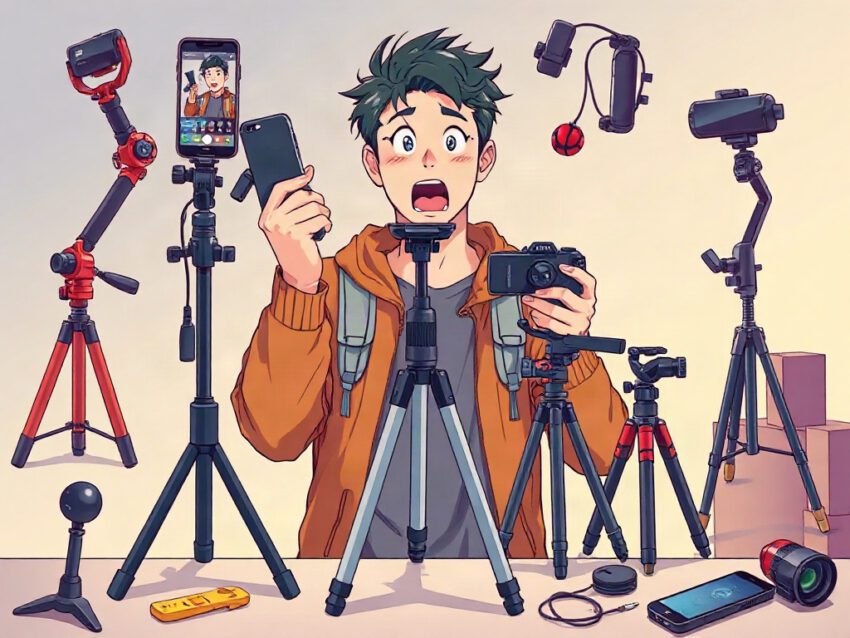
Best Tripods And Phone Stands On Amazon: A Practical Guide For Better Photos, Videos, And Everyday Life
Friends, there is a small, slightly embarrassing moment familiar to almost everyone.
You prop your phone against a coffee mug. The mug slides. The camera points at the ceiling. You try again with a stack of books, but one book is too soft, another is crooked, and the whole arrangement collapses precisely when you finally sit down.
Or perhaps you have stood in front of a beautiful view—a quiet lake at sunset, an old street glowing after rain, a mountain trail washed in gold—and realized that you have no good way to capture the moment without asking a stranger to take the picture.
That is where a tripod or phone stand quietly changes things.
It does not make you a professional photographer overnight. It does something more useful: it gives your phone a stable place to see the world. A good stand can improve video calls, product photos, online lessons, cooking videos, family portraits, time-lapse recordings, and even the simple act of watching a movie without holding your device for an hour.
Amazon offers thousands of tripods, selfie-stick tripods, tabletop stands, overhead mounts, and adjustable phone holders. The choice can feel absurd. Some models cost less than lunch. Others cost as much as a weekend away. Which one deserves your money?
The answer depends less on the product description and more on how you actually use your phone.
The difference between a tripod and a phone stand
The words often appear together, but they describe slightly different tools.
A phone stand usually belongs on a desk, nightstand, kitchen counter, or bedside table. It keeps your phone upright or tilted at a comfortable angle. Most stands remain in one place. They are excellent for:
- Video calls
- Watching videos
- Reading recipes
- Displaying notifications
- Recording desk-based content
- Charging while the phone remains visible
- Keeping a phone at eye level during work
A phone tripod is more mobile and adjustable. It normally has three legs, a phone clamp, and some form of height or angle adjustment. Many models also function as selfie sticks. They are better for:
- Full-body photos
- Group pictures
- Travel photography
- Reels and short videos
- Exercise demonstrations
- Presentations
- Outdoor filming
- Stable long-exposure or time-lapse shots
A stand says, “Keep the phone here.”
A tripod says, “Put the phone there, step back, and let the camera work.”
That distinction sounds simple, but it prevents a common buying mistake: purchasing a beautiful desk stand when what you really need is a device that can reach chest height across a room.
What makes a phone tripod worth buying?
A cheap tripod can still be useful. Price alone does not determine quality. However, certain design features separate a dependable model from a frustrating one.
Stability
Stability comes first.
A tall tripod with narrow legs may look impressive in a product photo, but if a small bump sends it falling forward, the extra height becomes a liability. Look for:
- Wide, well-spaced legs
- Rubber feet
- A sturdy central column
- A phone clamp that does not wobble
- Locking mechanisms that feel firm
- A base that remains balanced when the phone tilts
Think about where you will use it. On a smooth desk, compact rubber feet may be enough. On carpet or uneven ground, a more substantial tripod will serve you better.
There is a particular kind of panic that appears when an expensive phone begins to lean toward the edge of a table. A stable tripod prevents that panic before it starts.
Height range
A tabletop tripod may rise only a few inches. A travel tripod might extend to around 40 or 50 inches. Full-size phone tripods can reach approximately 60 to 72 inches, depending on the design.
Choose based on the camera angle you need:
- Under 12 inches: desk work, close-up filming, low-angle shots
- 12 to 40 inches: tabletop demonstrations, seated videos, travel use
- 40 to 60 inches: portraits, cooking tutorials, standing presentations
- 60 inches and above: eye-level recording, group photos, full-body content
A phone positioned too low creates an unflattering angle. A phone positioned too high can make you look small and distant. For talking-head videos, eye-level placement usually feels the most natural.
Clamp quality
The clamp holds the phone, so it deserves more attention than it receives.
A good clamp should:
- Open wide enough for your phone and case
- Grip firmly without pressing dangerously on buttons
- Hold the phone horizontally or vertically
- Allow quick adjustments
- Avoid covering the camera lenses
- Remain secure when the tripod tilts
If you use a thick protective case, check the clamp’s listed width. A holder that fits a bare phone may not fit a rugged case.
Many popular Amazon models include a spring-loaded universal phone holder. These are convenient, but they can vary widely in strength. Read customer comments specifically for phrases such as “falls over,” “too tight,” “does not fit with case,” and “phone slowly tilts.”
Rotation and viewing angles
A tripod with a rotating phone mount gives you more freedom.
You may want a vertical frame for short-form video, a horizontal frame for a family call, or a slight downward angle for filming a recipe. A 360-degree ball head or rotating holder can make those changes quick.
However, flexibility should not mean looseness. A mount that rotates beautifully but cannot stay in position is not flexible; it is unreliable.
The best types of Amazon phone tripods
Instead of naming one universal winner, it makes more sense to divide the market into useful categories. The right choice for a travel blogger may be completely wrong for someone who needs a phone beside a laptop.
Best for travel: foldable selfie-stick tripods
The foldable selfie-stick tripod remains one of the most popular designs on Amazon. These models combine three tools:
- Selfie stick
- Handheld phone grip
- Freestanding tripod
Many include a wireless remote shutter, allowing you to take a photo several feet away without touching the phone. Amazon’s current best-seller pages feature multiple models in this category, including compact 50-inch and taller versions designed for iPhone and Android devices.[1][2]
This style works well for travelers because it packs down quickly. You can carry it in a backpack, pull it out at a viewpoint, extend the legs, and capture a photograph without interrupting the entire group.
The compromise is stability. A lightweight selfie-stick tripod may stand perfectly still indoors but struggle in wind or on uneven ground. If you plan to use it near a cliff, beach, or busy walkway, choose a model with a broad base rather than the lightest possible option.
Best for standing videos: tall adjustable tripods
Tall tripods are designed for creators, teachers, fitness instructors, and anyone who wants the phone near eye level.
A model extending to roughly 60 or 70 inches can record:
- Standing tutorials
- Dance practice
- Workout sessions
- Outfit videos
- Presentations
- Full-body portraits
- Small business demonstrations
Amazon listings commonly advertise heights between 62 and 71 inches, along with remote controls and phone holders.[2][4]
Before buying, check how the tripod behaves at full extension. Maximum height often comes with reduced stability. If you record indoors on a hard floor, the design may perform perfectly. If children, pets, or busy feet move around the room, a shorter, heavier tripod may be safer.
Best for desks: mini tripods and tabletop stands
A mini tripod makes sense when the phone should remain close.
Picture a small home office. Your laptop hums quietly, a mug of tea cools beside the keyboard, and your phone needs to show a recipe, a meeting, or a reference image. A tabletop stand keeps everything visible without taking up much space.
Mini tripods are also useful for:
- Product photography
- Close-up crafts
- Makeup tutorials
- Unboxing videos
- Stop-motion projects
- Calls from a desk
- Recording hands-only demonstrations
The Manfrotto Pixi Evo, for example, is frequently included in editorial recommendations for compact phone filming setups, although its higher price reflects a more camera-oriented design.[9]
A small tripod will not replace a tall model. It does not need to. Its strength lies in convenience.
Best for serious filming: camera-compatible phone tripods
Some phone tripods include a universal screw mount that can support a small camera, action camera, or additional accessory. This is useful if you expect your equipment needs to grow.
Look for:
- Standard camera mounting threads
- A removable phone clamp
- A metal or reinforced central connection
- Stronger leg locks
- Compatibility with lights or microphones
Amazon’s tripod categories include models advertised for both smartphones and cameras, with examples listing remote controls, phone holders, and travel-oriented designs.[1][5]
A camera-compatible tripod may cost more and weigh more, but it can remain useful after you move beyond phone photography.
The best types of Amazon phone stands
Phone stands look simpler than tripods, yet their differences become obvious after a week of daily use.
Adjustable desk stands
An adjustable stand lets you change the height and viewing angle. This matters during video calls because a low phone forces you to look downward, creating the familiar “chin camera” effect.
A good desk stand should have:
- A heavy or wide base
- A non-slip surface
- Adjustable tilt
- Enough clearance for a charging cable
- A cradle deep enough for your phone case
- Smooth movement without sudden drops
For remote work, place the phone beside—not directly in front of—the laptop camera. It can display messages, meeting notes, or a second video window without blocking the main screen.
Bedside stands
A bedside stand should prioritize balance and cable access. Avoid a design with a narrow base if you regularly reach for the phone in the dark. A stable base prevents the stand from tipping when you grab the device half-awake at 6 a.m.
Look for a holder that supports:
- Portrait orientation
- Landscape orientation
- Charging while mounted
- A thicker case
- One-handed removal
The best bedside stand is rarely the most decorative one. It is the one that stays exactly where you left it.
Kitchen and recipe stands
Kitchen stands face a harsher environment: splashes, flour, oil, hurried hands, and the occasional wet counter.
Choose a stand with:
- A broad base
- Easy-to-clean surfaces
- A raised phone cradle
- A viewing angle that prevents glare
- Enough weight to resist accidental knocks
Place the phone away from the sink and stove, even if the product appears sturdy. No stand can protect a phone from boiling water or a pan of sizzling oil.
MagSafe-compatible stands
Magnetic stands can be wonderfully convenient if your phone and case support a compatible magnetic system. You can attach and remove the phone quickly, often with one hand.
Still, magnetic strength varies. A thin, well-aligned phone may hold securely, while a heavy case or poorly positioned ring can reduce grip. If you use a non-MagSafe phone, check whether the stand includes an adhesive magnetic ring or a mechanical clamp.
A magnet is not a substitute for stability. It is a method of attachment.
📢 Join Our Telegram Channel
Get real-time updates on new deals, price drops, and hidden tech gems.
⏰ Be first to see hot offers🛒 Direct links to products🎯 Focus on practical, useful tech

## How to choose the right tripod for your phone
Friends, the smartest purchase begins with a small act of honesty: describe the moment when you will use the product.
Not the imaginary version of yourself who records cinematic travel videos every weekend. The real version. The one standing in a narrow apartment hallway, working from a kitchen table, or trying to take a family picture before the toddler loses patience.
Ask these questions.
Where will the tripod live?
If it stays on a desk, choose a mini tripod or adjustable phone stand.
If it travels in a backpack, prioritize folded size and weight.
If it remains in a studio or home office, choose stability over portability.
If it moves between rooms, select a model that folds quickly and does not require complicated assembly.
A tripod that takes three minutes to unfold may be technically portable, but you will use it less often than a model that opens in ten seconds.
What will you record?
Different activities need different camera positions.
For video calls, use an adjustable stand near eye level.
For selfies, a selfie-stick tripod with a remote is convenient.
For full-body videos, select a tall tripod with a wide base.
For cooking content, choose a stable stand that can angle downward.
For product photography, use a tabletop tripod with precise adjustment.
For travel portraits, choose a compact tripod with a secure remote shutter.
For outdoor filming, look for stronger legs and rubber feet rather than maximum height.
How often will you move it?
Portability sounds universally good, but every gram removed from a tripod can reduce stability. A featherlight model feels wonderful in a suitcase; it feels less wonderful when a breeze knocks it over.
Use this simple rule:
- Move it daily: choose light and foldable
- Move it weekly: choose a balanced middleweight model
- Keep it in one place: choose the heaviest stable model you can comfortably afford
Does the remote control matter?
A Bluetooth remote can be one of the most useful accessories included with a phone tripod. It lets you begin recording or capture a photo from several feet away.
Before trusting the remote, check:
- Whether it works with both iPhone and Android
- Whether it uses a replaceable battery
- Whether pairing is simple
- Whether it has a physical power switch
- Whether reviews mention random disconnections
Keep the remote in the tripod’s carrying pouch. Otherwise, it will disappear into the same mysterious part of the house that consumes charging cables and single socks.
Features that deserve attention
Product descriptions often overflow with impressive phrases. “Professional,” “premium,” “360-degree,” “heavy-duty,” and “universal” appear everywhere. Translate those words into practical questions.
Remote shutter
Useful for group photos, full-body images, and hands-free recording.
Fill light
Some phone tripods include built-in LED lights. These can help in dark rooms, but brightness and color quality vary. A small light is helpful, not magical. It will not transform a dim room into a studio.
Carrying bag
A bag protects the tripod from scratches and makes travel easier. It also creates a home for the remote, which is more important than it sounds.
Cold shoe or accessory mount
This lets you attach a microphone or small light. It is valuable for creators who want cleaner audio or better illumination.
Ball head
A ball head provides flexible positioning, but it must lock firmly. If it slowly droops during recording, the feature becomes a source of irritation.
Metal components
Metal at the phone mount, screw connection, or central joint can improve durability. However, an all-metal tripod may be heavier. Consider where you will carry it.
Cable clearance
If you plan to charge while recording, make sure the holder leaves space around the charging port. A surprisingly large number of otherwise useful stands make cable placement awkward.
How to read Amazon reviews without wasting an hour
Star ratings help, but they do not tell the entire story.
A product with thousands of reviews may have a high average rating because most buyers use it casually. A photographer may discover weaknesses that do not matter to someone who only watches videos at a desk.
Read reviews in this order:
- Look at the most recent reviews.
- Search within reviews for “stability.”
- Search for “case.”
- Search for “remote.”
- Search for “falls.”
- Read the one-star and three-star comments.
- Compare complaints with your intended use.
One-star reviews can be exaggerated, but repeated complaints reveal patterns. If several buyers mention that the legs spread too easily, the issue probably matters. If one person says the box arrived crushed, that says little about the design.
Pay attention to photographs. Real customer images often show the product’s true scale better than polished studio pictures. A tripod advertised as “compact” may be tiny enough for a desk—or too small for the room you imagined.
Common mistakes when buying a phone stand
The first mistake is choosing by maximum height alone.
A 72-inch tripod sounds impressive. But if it becomes unstable above 60 inches, that extra foot provides little value.
The second mistake is ignoring the phone case.
A thick case, wallet attachment, or grip can prevent the clamp from closing correctly. Measure the phone and case together.
The third mistake is expecting a lightweight tripod to behave like a studio stand.
Physics remains stubborn. A tall, narrow, lightweight object will always be more vulnerable to movement than a short, wide, heavy one.
The fourth mistake is forgetting the camera lens position.
Some clamps cover part of the lens on phones with unusual camera layouts. Test the framing before recording a long session.
The fifth mistake is buying a stand that cannot tilt enough.
A phone that remains perfectly vertical may be fine for calls but useless for filming a countertop. Think about the angle before you buy.
The sixth mistake is believing every included remote works equally well.
Remote shutters are convenient, but some require repeated pairing or have a short range. Treat the remote as a bonus unless hands-free shooting is central to your plans.
A simple buying guide by budget
You do not need to spend a fortune to get a useful phone stand.
Under $20
Expect basic plastic construction, modest stability, and limited height. These models can work well for:
- Desk use
- Casual selfies
- Simple video calls
- Occasional travel
At this price, inspect the clamp and leg locks carefully. A very cheap tripod may be perfectly adequate for indoor use and disappointing outdoors.
Around $20 to $40
This range often offers the best balance for ordinary users. You may find:
- Taller extension
- Wireless remote
- Rotating phone holder
- Carrying bag
- Better rubber feet
- More useful adjustment
Amazon best-seller listings include phone tripod models around this range, including compact travel-oriented options.[1][3]
Around $40 to $80
Here, you can expect stronger construction, smoother adjustment, better stability, and more camera compatibility. This range suits frequent creators, educators, travelers, and people who dislike replacing cheap accessories every few months.
Above $80
Higher prices make sense when you need precision, durability, or compatibility with cameras and accessories. A premium compact tripod such as the Manfrotto Pixi Evo appears in editorial recommendations for smartphone filming, though it costs considerably more than basic Amazon selfie-stick designs.[9]
The right question is not “What is the cheapest tripod?”
It is “What failure would annoy me most?”
If a fallen phone could ruin a recording, buy stability. If carrying weight would make you leave the tripod at home, buy portability. If you only need a phone at eye level during calls, a simple stand may be enough.
How to use a tripod for better photos
A tripod cannot compose the image for you, but it gives you time to compose it yourself.
Set the phone at the desired height. Then walk into the frame and check the edges. Look for clutter, bright windows, crooked horizons, and objects that appear to grow from someone’s head.
Use the grid option in your camera app if available. Align the horizon. Leave a little space above the head. Avoid placing the subject directly against a distracting background.
For a family photograph:
- Place the tripod on stable ground.
- Use the rear camera if possible.
- Set a timer or wireless remote.
- Take several frames.
- Check everyone’s eyes before leaving.
- Keep the phone away from direct sunlight.
- Retrieve the tripod before packing the snacks.
For a self-portrait, do not stand too close to the phone. Step back and let the frame breathe. A little space around the body often feels more natural than a tightly cropped image.
How to use a stand for better video calls
Raise the phone until the camera sits near eye level. This small adjustment changes the entire conversation.
Place the phone about an arm’s length away. Clean the lens with a soft cloth. Face a window if possible, but avoid putting the window directly behind you. Light should fall toward your face, not turn you into a silhouette.
Keep the background simple. The viewer does not need to inspect every object in your room. A plant, shelf, or blank wall can create a calm visual field.
If you use a stand beside your computer, silence unnecessary notifications. A phone that remains visible can help you stay organized; it can also become a tiny machine for distraction. Technology offers both possibilities at once.
Safety and durability
Never place a tall phone tripod where someone can catch their foot on the legs. Keep it away from stairs, doorways, pets, and the edge of a table.
When filming outdoors:
- Extend the thickest leg sections first.
- Keep the center of gravity low in strong wind.
- Avoid placing the tripod near water.
- Use a bag or weight as a counterbalance.
- Do not leave the phone unattended.
- Collapse the tripod before walking away.
Check the joints occasionally. Plastic locks can loosen over time. Wipe sand and dust from moving parts before folding the legs. Store the tripod dry, especially after a beach trip.
A good accessory should make your life easier, not create a new hazard.
The deeper reason these small tools matter
A tripod seems like a piece of plastic, aluminum, rubber, and spring tension. Yet its real value has little to do with those materials.
It gives people permission to participate in their own memories.
Without a tripod, someone must stand behind the camera. The photographer disappears from birthdays, vacations, hikes, and ordinary Sunday dinners. With a tripod, the person holding the phone can step into the frame.
That matters.
Years later, nobody studies the perfect lighting first. People look for faces. They search for the person who was always taking the picture and never appearing in it.
A phone stand offers another kind of freedom. It lets you place the device down. During a video call, that means your hands can remain free. While cooking, you can read without smearing flour across the screen. While working, you can see the phone without constantly picking it up.
The stand creates a little distance between the person and the device. Sometimes that distance is exactly what we need.
Final recommendations
For most buyers, the best Amazon tripod is a foldable model with a secure phone clamp, adjustable height, a rotating mount, rubber feet, and a wireless remote. This combination handles travel, casual photography, video calls, and short-form content without demanding too much money or space.[1][2][4]
For a desk, choose an adjustable phone stand with a heavy base and charging clearance.
For travel, choose a compact selfie-stick tripod that folds small but has a reasonably wide base.
For standing videos, choose a tall tripod with firm leg locks and a phone holder that does not sag.
For product demonstrations and recipes, choose a mini tripod or overhead-capable stand with smooth angle adjustment.
For long-term use, spend more on stability and construction, not just extra height or flashy accessories.
And before pressing “Buy,” picture the exact scene: the room, the floor, the phone case, the angle, the distance, the person who will stand in front of the lens. The right tripod will not merely hold your phone. It will quietly remove one more obstacle between you and the thing you want to create.
Friends, sometimes a better photograph begins with a very ordinary decision: stop balancing the phone against a coffee mug, give it a steady place to stand, and step into your own story before the light disappears.
📢 Join Our Telegram Channel
Get real-time updates on new deals, price drops, and hidden tech gems.
⏰ Be first to see hot offers🛒 Direct links to products🎯 Focus on practical, useful tech