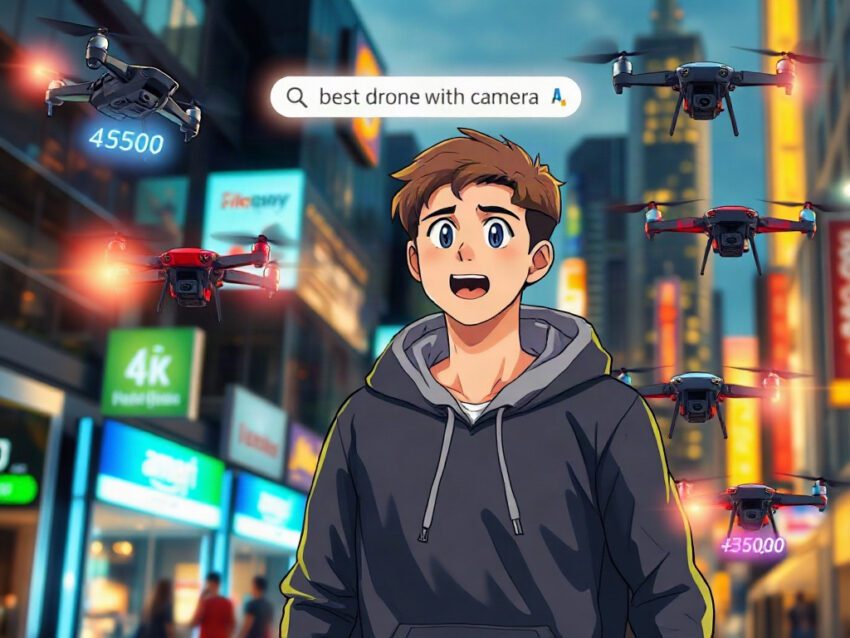
Best Drones People Search For on Amazon
Buying a drone on Amazon can feel strangely similar to standing in a crowded airport terminal. Every product promises adventure. Every box shows a perfect sunset, a smiling family, and a machine hovering obediently above a turquoise lake. Then you look at the specifications and the mood changes.
One drone says 4K. Another promises 50 minutes of flight time. A third claims professional photography at a surprisingly low price. Somewhere below, a customer writes, “Amazing!” while another says, “Stopped working after three days.”
Friends, the best drone is not always the one with the longest feature list. It is the one that matches the way you actually plan to fly: in a backyard, above a beach, on a hiking trip, around a farm, or simply through the living room while your dog watches in suspicious silence.
Amazon’s drone marketplace includes thousands of listings, while its best-selling categories prominently feature models such as the DJI Mini 4K and inexpensive beginner drones with cameras.[1][2] This guide focuses on the drones people most often search for, the features that genuinely matter, and the traps that make an exciting purchase turn into an expensive paperweight.
Why Amazon drone searches can be confusing
Search for “best drone with camera” and the results arrive like a flock of birds startled from a roof. There are compact camera drones, toy drones, racing drones, GPS drones, foldable drones, thermal-imaging platforms, and miniature indoor models that barely weigh more than a sandwich.
The first question is simple:
What do you want the drone to do?
That question matters more than the word “best.”
A parent searching for a birthday gift may need a durable, inexpensive drone that survives imperfect landings. A traveler may care about weight, battery life, and the quality of the carrying case. A real-estate photographer needs stable video, reliable positioning, and a camera that does not turn white walls into gray soup. A teenager interested in FPV flying may want speed and immersive goggles rather than a calm, automated camera platform.
Before opening another product page, define your mission:
- Learning: inexpensive controls, propeller guards, simple takeoff and landing.
- Travel photography: low weight, foldable design, strong stabilization, spare batteries.
- Family entertainment: durability, obstacle tolerance, easy repairs, affordable replacement parts.
- Professional-looking footage: large sensor, mechanical gimbal, reliable transmission, advanced flight modes.
- FPV excitement: low-latency video, responsive controls, goggles, and crash-resistant construction.
- Outdoor exploration: GPS, return-to-home, wind resistance, long-range transmission, and dependable battery management.
Without this decision, shoppers often buy a drone because its product photograph looks impressive. That is how a $70 toy ends up being judged against a $1,000 aerial camera.
The most searched drone categories on Amazon
People rarely search only for a brand name. They search for a solution: “drone under 250g,” “drone with 4K camera,” “best drone for beginners,” or “long flight time drone.” These search phrases reveal what buyers fear and desire.
They fear complicated controls, weak batteries, broken propellers, blurry footage, and losing the drone over a pond.
They desire freedom.
Drones under 250 grams
Compact drones under 250 grams attract travelers and beginners because they are easier to carry and, in many locations, may fall under different registration requirements than heavier aircraft. Regulations vary by country and can change, so weight alone never tells the whole legal story.
The DJI Mini 4K is one of the most visible options in Amazon’s best-seller listings. Its appeal comes from a compact design, 4K video, mechanical stabilization, automated return-to-home, and a weight below the 250-gram threshold.[2]
A light drone feels liberating. You can place it in a small backpack beside a sweater and a paperback. You can hike for two hours without feeling as though you are carrying a second camera bag.
But small does not mean invincible. Light drones can react sharply to wind, and a compact battery may deliver less practical flight time than its packaging suggests. Manufacturers usually advertise maximum flight time in controlled conditions. In real use, the drone must reserve power for the return journey, and cold weather can reduce battery performance.
When comparing lightweight models, check:
- Actual takeoff weight with the battery installed.
- Whether the package includes one or several batteries.
- Availability of replacement batteries and propellers.
- Wind-resistance claims and independent reviews.
- Whether the controller includes a built-in screen or requires a phone.
- Video transmission distance in realistic conditions.
A drone that flies for 31 minutes in a laboratory may give you 22 to 26 useful minutes outdoors. That difference matters when the sunset is already slipping behind the hills.
Camera drones with 4K video
“4K drone” is one of the strongest phrases in the category, but the label alone tells only part of the story.
A cheap drone may record a file described as 4K while using a small sensor, weak image processing, digital stabilization, and heavy compression. In bright midday light, the footage can look acceptable. At dusk, the sky becomes noisy, shadows lose detail, and the image may shake like a hand holding a paper cup on a moving bus.
A better camera drone usually combines several elements:
- A mechanical gimbal, often with three-axis stabilization.
- A sensor large enough to capture detail in mixed lighting.
- A reliable video transmission system.
- Adjustable exposure settings.
- A lens with enough sharpness across the frame.
- A stable app that does not disconnect at the worst possible moment.
The gimbal deserves special attention. Electronic stabilization can smooth minor movement, but a mechanical gimbal physically keeps the camera level. When the drone tilts forward to move, the horizon can remain calm. That calm horizon creates the difference between footage that feels cinematic and footage that makes viewers reach for motion-sickness tablets.
Ask yourself what you plan to film. If you want family videos and occasional travel clips, a capable compact drone may be enough. If you want to create commercial property tours, landscapes, or documentary footage, camera quality and transmission reliability should outrank novelty features.
Beginner drones
Beginner drones dominate Amazon because many people want to learn without risking hundreds of dollars. These models often include one-button takeoff, altitude hold, headless mode, speed adjustment, and automatic landing.
They can be excellent for building confidence.
The first flight rarely looks graceful. The drone rises, drifts sideways, bumps into a hedge, and lands in a patch of grass. The pilot stares at the controller as if it has personally betrayed the family. Ten minutes later, everyone laughs. Twenty minutes after that, the pilot begins learning.
A beginner drone should forgive mistakes. Look for:
- Propeller guards.
- Soft or flexible propellers.
- Spare propellers included in the box.
- Two batteries rather than one.
- A clear instruction manual.
- Simple controls.
- A replacement-parts store.
- A return policy that does not create a second problem.
Some low-cost listings advertise “obstacle avoidance” when they actually provide only basic collision sensing or decorative sensors. Read the manual and customer questions carefully. A pair of black plastic circles on the front does not automatically mean the drone can safely navigate around trees.
Altitude hold is useful, but it is not GPS positioning. A drone may maintain approximate height while drifting horizontally. Indoors, air currents from fans and heating systems can push it around. Outdoors, wind can carry it farther than a beginner expects.
Start in a wide open area. Keep the drone low. Practice hovering, forward movement, backward movement, and landing before attempting dramatic shots.
The sky will still be there tomorrow.
GPS drones
GPS drones appeal to buyers who want greater stability and extra safety features. GPS positioning can help the aircraft hold its location, record a home point, and return toward the takeoff area when the signal drops or the battery becomes critically low.
That sounds reassuring, and it is useful. But “return to home” is not a magical rescue spell.
The pilot must set the home point correctly, monitor the surrounding environment, and understand the drone’s return altitude. If a tree stands between the drone and the launch site, the aircraft may return at a height that does not clear the branches. If the takeoff location changes, the recorded home point may no longer be where the pilot expects.
A good GPS drone should offer:
- A visible satellite count or positioning indicator.
- A clear home-point confirmation.
- Return-to-home settings.
- Low-battery warnings.
- Signal-loss behavior that can be configured.
- A map showing the aircraft’s current location.
- A practical emergency landing option.
GPS improves confidence, but it does not replace attention. The best safety system remains a pilot who watches the drone instead of staring only at the phone screen.
FPV drones
FPV means first-person view. Instead of watching the drone from the ground, the pilot sees the world through the aircraft’s camera, often using goggles.
The sensation can be astonishing. A narrow path suddenly becomes a runway. A park bench becomes an obstacle. The drone dives, turns, and rises with the kind of speed that makes ordinary flying feel almost too quiet.
FPV flying rewards practice and punishes impatience.
These drones tend to be faster and more responsive than camera drones designed for relaxed aerial photography. They may require more space, more technical knowledge, and more willingness to repair equipment after a crash. Some systems offer assisted modes for beginners, while others assume the pilot already understands throttle control and orientation.
Choose an FPV drone if you want:
- Speed and acrobatic movement.
- Immersive goggles-based flying.
- Low-latency video.
- Racing or freestyle practice.
- A hobby that involves both flying and tinkering.
Do not choose one simply because the footage looks dramatic. FPV systems can be more demanding, and the learning curve may feel steep when the drone is suddenly upside down above a field.
The Amazon listings worth examining carefully
Product pages often use large fonts for the most flattering number and small text for the practical limitations. Treat the listing like a contract written by an enthusiastic salesperson.
Look beyond the title.
Flight time
Manufacturers may list flight time under ideal conditions with no wind, no aggressive movement, and a battery discharged only to its recommended limit. Your real flight time will likely be shorter.
If a package includes three batteries, calculate the total practical flying experience, not the number printed beside a single battery. Also verify whether the charger can charge multiple batteries simultaneously or whether you will spend the evening waiting for a tiny light to turn green.
Transmission distance
A listing may promise several miles of transmission distance. That figure often assumes a clear, interference-free environment. Buildings, trees, hills, radio interference, and local regulations can reduce the practical range.
More importantly, long range does not mean you should fly that far. Many jurisdictions require the aircraft to remain within visual line of sight. A drone disappearing behind a ridge is not an adventure; it is a missing-aircraft investigation beginning in slow motion.
Camera resolution
Check whether “4K” describes photos, video, or both. Look for video frame rates and stabilization details. A camera that records 4K at 30 frames per second may suit landscape footage, while a model that offers higher frame rates can produce smoother action sequences.
Ask whether the drone saves footage to a memory card or only to a phone. Phone-captured footage may be lower quality because it is transmitted and compressed during flight.
Obstacle avoidance
Obstacle sensing can reduce risk, but systems vary. Some detect objects only in front. Others detect obstacles in several directions. Some work only in particular flight modes or lighting conditions.
Never assume that obstacle avoidance sees thin branches, power lines, glass, or dark objects reliably. A drone can avoid a large wall and still lose an argument with a telephone wire.
Customer reviews
Do not read only the average star rating. Read reviews from people who resemble you.
A reviewer flying in a warm, calm coastal climate may have a different experience from someone launching in a cold city with strong winds. Search reviews for recurring terms:
- GPS drift.
- App crashes.
- Battery swelling.
- Gimbal vibration.
- Controller disconnects.
- Missing accessories.
- Weak customer support.
- Difficult firmware updates.
- Confusing instructions.
- Replacement parts.
Three similar complaints carry more weight than one furious review written after a bad afternoon.
📢 Join Our Telegram Channel
Get real-time updates on new deals, price drops, and hidden tech gems.
⏰ Be first to see hot offers🛒 Direct links to products🎯 Focus on practical, useful tech

## Popular drones people search for on Amazon
The following categories represent the models and product types that repeatedly attract attention. They should not be treated as a permanent ranking because prices, stock, bundles, regulations, and software support change over time.
DJI Mini 4K
The DJI Mini 4K appears prominently in Amazon’s best-selling quadcopter listings and is positioned as a compact camera drone for consumers who want stabilized 4K video without carrying a large aircraft.[2]
Its strongest appeal is balance. It is small enough for travel, capable enough for serious-looking footage, and less intimidating than a professional platform. A beginner can grow into it rather than immediately outgrowing it.
It suits:
- Travelers.
- New pilots who want camera quality.
- Families documenting holidays.
- Hikers and landscape photographers.
- Buyers who prefer a known ecosystem.
It may not suit:
- Pilots who want advanced all-direction obstacle avoidance.
- People flying regularly in strong wind.
- Creators who need the largest possible sensor.
- Buyers seeking the lowest possible price.
Think of the Mini 4K as a compact mirrorless camera in the sky: portable, capable, and happiest when the pilot understands its limits.
DJI Mini 2 SE
The DJI Mini 2 SE remains a popular search result for beginners looking for a compact drone, GPS positioning, automated return, and a relatively approachable price. Amazon search results highlight versions with extended battery bundles and advertised flight times reaching more than 90 minutes across multiple batteries.[3]
The distinction matters. A product page may say “93 minutes of flight time,” but that may refer to three batteries combined rather than one uninterrupted flight. Read the bundle details.
The Mini 2 SE makes sense for a buyer who values ease of use more than the newest camera specifications. Its camera can capture useful aerial images, though buyers seeking highly detailed 4K video should compare it with newer models.
Imagine standing on a hill above a lake at 6:40 in the evening. The air cools, the water turns silver, and the drone rises quietly from your palm. For many people, that experience matters more than whether every pixel meets professional production standards.
DJI Mini 4 Pro
The DJI Mini 4 Pro attracts buyers searching for a lightweight drone with more advanced camera capabilities and intelligent flight features. Professional testing and buying guides continue to identify it as a strong choice for creators who want a small aircraft without giving up premium features.[4]
Its audience includes:
- Travel filmmakers.
- Social media creators.
- Real-estate hobbyists.
- Enthusiasts who want more room to grow.
- Pilots who care about vertical video and advanced automation.
The trade-off is price. A premium compact drone can cost several times more than a basic beginner model, and the financial pain of a crash feels sharper when the aircraft leaves a crater in the budget.
If you choose a model in this class, budget for more than the drone:
- Extra batteries.
- A proper charging hub.
- A memory card suited to high-bitrate video.
- Spare propellers.
- A carrying case.
- Insurance or a protection plan where appropriate.
A camera drone is not just a gadget. It is a small flying computer with motors, sensors, firmware, batteries, and a camera hanging beneath it. Treat it like equipment.
DJI Air 3S
The DJI Air 3S is commonly recommended for buyers who prioritize image quality and advanced performance over minimal size. A recent buying guide lists it as a top overall drone at a price around $1,099, placing it above lightweight beginner models in both capability and cost.[5]
The Air series makes sense for serious enthusiasts and creators who want:
- Stronger wind performance.
- More advanced cameras.
- Greater dynamic range.
- Longer practical outings.
- A more substantial controller and aircraft.
It is less convenient for casual travelers. The aircraft, batteries, and accessories occupy more space, and carrying it through a city all day feels different from slipping a mini drone into a jacket pocket.
Here is the uncomfortable question: will you use the extra capability?
If your footage goes straight from the phone to a family group chat, a premium drone may be unnecessary. If you edit footage, sell images, document properties, or build a creative portfolio, the investment may make sense.
Low-cost 2K and 4K beginner drones
Amazon contains a large number of inexpensive drones marketed to adults, teens, and children. Typical listings emphasize altitude hold, one-button takeoff, headless mode, foldable arms, two batteries, and a camera.[2]
These drones can provide genuine fun. They also require realistic expectations.
A low-cost drone may be excellent for learning basic orientation in an open field. It may not provide:
- Reliable GPS positioning.
- Professional stabilization.
- Strong wind resistance.
- Precise return-to-home behavior.
- Consistent app performance.
- Long-term software support.
The best use case is recreational practice. You launch, fly a simple square, turn slowly, land, and repeat. You learn how the controls feel without worrying that one mistake will destroy a month’s savings.
For children, adult supervision remains essential. A spinning propeller can injure skin and eyes, and a small drone can cross a road or enter someone’s property in seconds.
Camera drones with long flight time
“Long flight time” appears in many Amazon searches because battery anxiety ruins the experience. A drone lands just as the landscape becomes beautiful. The pilot watches the final battery percentage fall and thinks, “I should have bought the bigger bundle.”
Look for the number of batteries, charging time, and battery-management system rather than trusting one headline figure.
A practical long-flight setup includes:
- At least two batteries.
- A charging hub.
- A safe battery case.
- A power bank or vehicle charger for trips.
- A clear plan for landing before the battery becomes critical.
Never drain a battery completely in the air. Leave enough power to return against wind, descend safely, and respond to an unexpected delay. The final minute of flight should never become a panic contest.
How to choose the right drone for your budget
Price can guide the decision, but it should not dictate it blindly.
Under $100
This range usually includes toy drones and entry-level camera drones. Expect basic image quality, limited stability, modest range, and simpler controls.
Choose this range when:
- You are learning.
- You want a gift.
- You expect occasional indoor or backyard use.
- You accept that crashes are part of the education.
Avoid buying one for professional video or reliable long-distance outdoor flying.
Between $100 and $500
This range often offers the best balance for casual adults and serious beginners. You may find GPS, foldable designs, better cameras, longer battery options, and stronger software.
Inspect the exact model carefully. Two drones with similar prices can differ dramatically in stabilization, parts availability, and support.
Above $500
This range includes advanced compact camera drones and more capable aircraft. Buyers should expect better image quality, improved flight performance, and more sophisticated automated features.
The extra cost becomes sensible when the drone supports a real purpose. If it helps create paid work, document a property, produce a film, or sustain a long-term hobby, it can be equipment rather than an impulse purchase.
What accessories actually matter
Amazon loves accessories because accessories multiply the number displayed beneath the “frequently bought together” label. Some are useful. Others gather dust beside the instruction manual.
Prioritize:
- Spare batteries.
- Spare propellers.
- A charging hub.
- A protective case.
- A fast, compatible memory card.
- A landing pad for dusty or wet ground.
- Propeller guards for beginners.
- A small toolkit for tightening screws and replacing parts.
A landing pad may seem silly until you launch from sand and hear grit scrape through the motors. A case may feel unnecessary until a controller presses against the drone during a train journey.
Avoid buying every accessory before your first flight. Learn what your flying habits require.
If you fly in parks, a bright landing pad helps locate the takeoff point. If you hike, a compact case protects the gimbal. If you film at dusk, spare batteries matter more than decorative lights.
Laws, privacy, and responsible flying
A drone does not become harmless because it is small. It remains an aircraft with a camera, a battery, and the ability to enter places where people expect privacy.
Rules vary by country, state, and local authority. Before flying, verify:
- Whether the drone must be registered.
- Whether the pilot needs a certificate or online test.
- Where recreational flying is permitted.
- Whether the area lies near an airport or restricted zone.
- Whether local parks prohibit takeoff and landing.
- What rules apply to recording people or private property.
- Whether night flying requires additional equipment or permission.
Never launch near emergency operations. Avoid crowds. Keep clear of airports, heliports, power lines, and busy roads. Do not follow strangers, look into windows, or treat a neighborhood as a film set.
A drone can reveal a beautiful coastline. It can also reveal how quickly technology crosses a boundary before the pilot notices.
Ask before filming identifiable people. Blur faces when appropriate. Store footage securely. Delete material that serves no purpose.
Responsible flying is not a boring add-on. It is what allows the hobby to survive.
A practical first-flight routine
The first flight should not begin with a dramatic climb above a forest. Begin with a checklist.
- Charge the aircraft battery and controller.
- Install the official app or confirm the controller connection.
- Update firmware at home, not beside a cliff.
- Check propellers for cracks.
- Confirm the battery is firmly attached.
- Choose an open area away from people and trees.
- Check weather and wind.
- Confirm the home point.
- Set a conservative return-to-home altitude.
- Take off to eye level and hover.
- Test forward, backward, left, and right movement.
- Practice a controlled landing.
- Review the battery level before attempting a second flight.
During the flight, keep the drone within sight. Do not let a phone notification steal your attention. Let calls wait. The sky is not a good place to multitask.
If the drone begins drifting, stay calm. Reduce movement, observe its direction, and land when safe. If the video feed freezes, do not immediately panic or press random buttons. Follow the manufacturer’s signal-loss procedure and maintain visual contact whenever possible.
The first flight teaches more than control. It teaches humility.
Common mistakes buyers make on Amazon
The most expensive mistake is choosing the wrong category.
A toy drone cannot become a professional camera platform because its title contains the words “4K HD.” A premium drone cannot become a carefree toy because it has an automatic landing mode.
Other frequent mistakes include:
- Buying one battery and expecting an afternoon of flying.
- Trusting maximum flight time without checking bundle details.
- Ignoring the return policy.
- Failing to verify replacement-parts availability.
- Choosing range over stability.
- Assuming GPS means collision avoidance.
- Flying in wind beyond the drone’s practical ability.
- Storing batteries fully charged for months.
- Skipping firmware updates or applying them outdoors.
- Recording strangers without considering privacy.
- Flying over water before learning basic control.
- Treating customer reviews as equally reliable.
A useful rule is this: buy the drone you can operate responsibly, not the drone whose advertisement makes you feel most adventurous.
Final comparison
| Drone type | Best for | Main strengths | Main limitations |
|---|---|---|---|
| Toy drone under $100 | Children, casual practice, indoor flying | Affordable, simple, often crash-tolerant | Weak camera, limited stability, short range |
| Compact beginner camera drone | New adult pilots and travelers | Portable, easier controls, useful aerial photos | Smaller sensors, limited advanced safety features |
| DJI Mini-class drone | Travel creators and enthusiasts | Lightweight, stabilized video, strong ecosystem | More expensive than toy drones, sensitive to strong wind |
| Advanced compact drone | Serious creators | Better cameras, intelligent flight modes, stronger performance | Higher price, more expensive crashes |
| FPV drone | Racing, freestyle, immersive flying | Speed, responsiveness, thrilling perspective | Steeper learning curve, more repairs and equipment |
| GPS drone with long battery bundles | Outdoor recreation | Position holding, return features, longer sessions | Advertised range and flight time may exceed real use |
The quiet question behind every drone purchase
A drone promises height, but height is not the real attraction.
The real attraction is perspective.
From above, the road becomes a line. The crowded beach becomes a pattern. The house where you spent twenty years becomes a small shape among trees. A person can stand in the same place for decades and never see it that way.
That change in perspective can be beautiful. It can also be unsettling.
A drone shows us that the world is larger than our daily path, but it also reveals how easily we become observers instead of participants. The pilot watches the sunset through a screen while the actual sunset happens behind them.
So when you choose among the best drones on Amazon, do not ask only which one has the sharpest camera or longest battery. Ask what kind of attention it will demand from you.
Will it help you notice the landscape?
Will it bring your family outdoors?
Will it teach patience, balance, and responsibility?
Or will it become another bright rectangle in a drawer, waiting for the next weekend that never arrives?
The best drone is the one that leaves the box, enters the sky, and gives you a reason to look up—not merely to capture the world, but to feel present inside it.
📢 Join Our Telegram Channel
Get real-time updates on new deals, price drops, and hidden tech gems.
⏰ Be first to see hot offers🛒 Direct links to products🎯 Focus on practical, useful tech